CloudFix vs AWS Trusted Advisor: Which Actually Reduces Your AWS Bill?

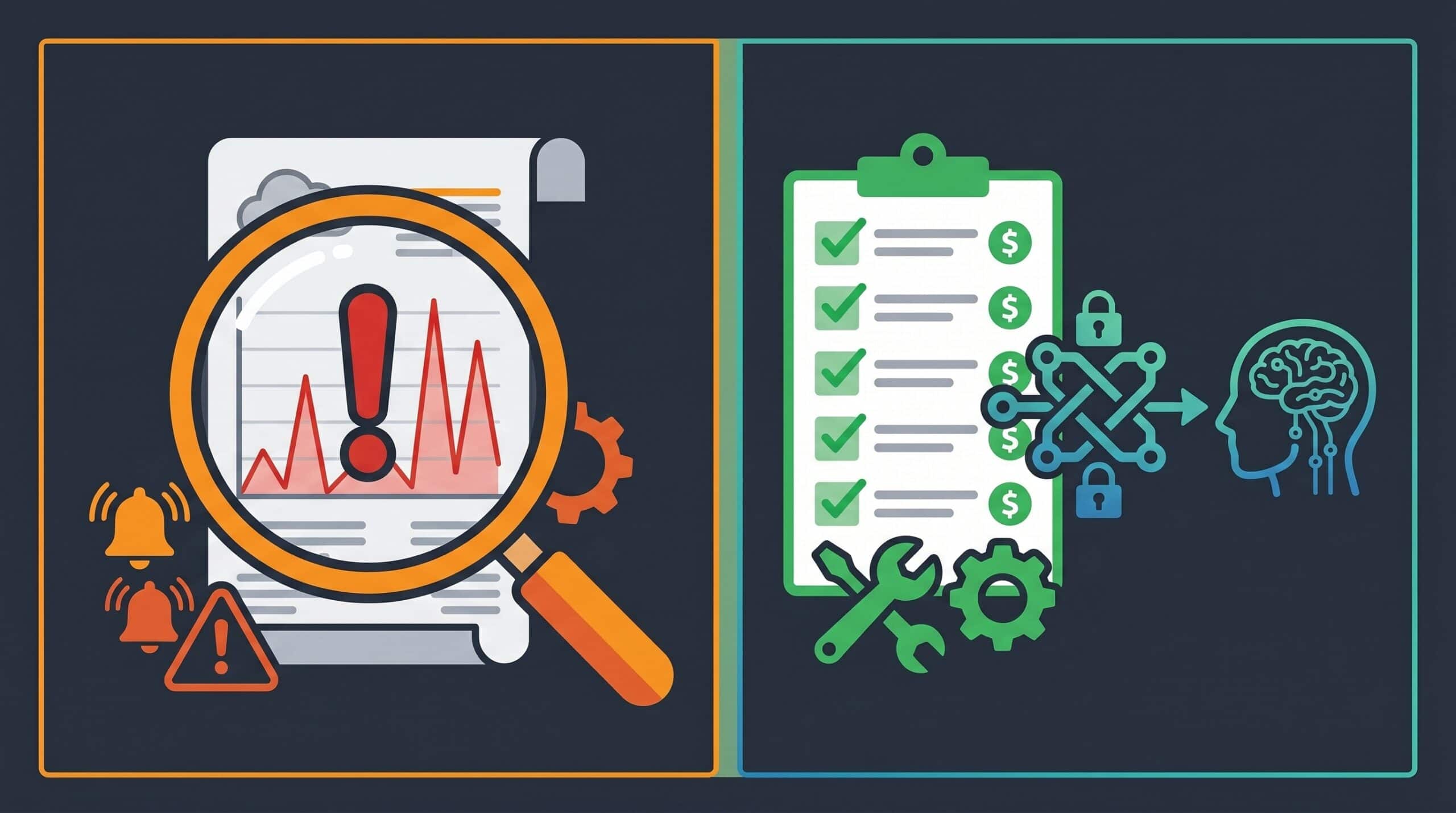
The Short Version: AWS Trusted Advisor has 44 cost optimization checks. CloudFix has 110+ finders across 30+ AWS services. The difference isn’t just breadth — it’s implementation. Trusted Advisor recommends. CloudFix recommends and fixes. One-click, via AWS SSM, with your approval.
If you’re using AWS Trusted Advisor for cost optimization, you’re getting solid recommendations from AWS. But someone still has to implement every single one of them. Here’s the detailed comparison.
Feature Comparison
| Feature | CloudFix | AWS Trusted Advisor |
|---|---|---|
| Number of cost checks | 110+ finders across 30+ AWS services | 44 cost optimization checks across 17+ services |
| Fix implementation | Yes — automated via AWS SSM with approval | No — recommendations only |
| Scope | EC2, EBS, S3, RDS, Lambda, DynamoDB, ElastiCache, OpenSearch, SageMaker, CloudWatch, CloudFront, EMR, EFS, EKS, ECS, VPC, Bedrock, and more | EC2, EBS, S3, RDS, Lambda, DynamoDB, ElastiCache, OpenSearch, Aurora, Redshift, Comprehend, MemoryDB, ECR, Fargate, Route 53, VPC/NAT/ELB |
| Automation | Automated scanning + one-click fix implementation | Automated scanning, manual implementation |
| Multi-account | Full AWS Organizations support | Per-account (Organization view limited) |
| Integration | Jira, ServiceNow, SSO/SAML | AWS console only |
| Pricing | Free scan. Paid tiers from $149/month | Free (limited checks) or with AWS Business/Enterprise Support ($100+/month) |
| Rollback | SSM-based with change tracking | N/A (no implementation) |
| AWS Marketplace | Yes — EDP eligible | AWS native |
Trusted Advisor checks. CloudFix fixes. See what CloudFix finds for you — free assessment.
What Trusted Advisor Actually Covers
Trusted Advisor’s cost optimization checks are broader than most people realize — 44 checks across 17+ services. The full list from AWS documentation:
- EC2: Instance right-sizing, stopped instances, Auto Scaling optimization, SQL Server consolidation, RI optimization, RI lease expiration, Savings Plans recs (8 checks)
- EBS: Volume optimization, over-provisioned volumes, underutilized volumes (3 checks)
- RDS: Instance optimization, storage optimization, idle DBs, RI purchase recs (4 checks)
- Aurora: DB cluster storage optimization (1 check)
- Lambda: Function optimization, excessive timeouts, high error rates, over-provisioned memory (4 checks)
- DynamoDB: Reserved capacity purchase recs (1 check)
- S3: Lifecycle policy, incomplete multipart uploads, version-enabled buckets without lifecycle (3 checks)
- OpenSearch: Reserved Instance purchase recs (1 check)
- ElastiCache: Reserved node purchase recs (1 check)
- Redshift: Reserved node purchase recs, underutilized clusters (2 checks)
- ECS/Fargate: Cost optimization for ECS (1 check)
- ECR: Repository lifecycle policy (1 check)
- Comprehend: Underutilized endpoints (1 check)
- MemoryDB: Reserved node purchase recs (1 check)
- Route 53: Latency record sets (1 check)
- Networking: Idle load balancers, idle/inactive NAT gateways, inactive VPC endpoints, inactive firewall, inactive GWLB, unassociated EIPs (7 checks)
- General: Organizations membership, Well-Architected cost issues, Savings Plans for compute, Savings Plans for SageMaker (4 checks)
That’s a solid set of checks. The newer ones (Aurora, EBS volumes, RDS instances, Lambda, Fargate) pull from AWS Cost Optimization Hub and Compute Optimizer, which require opt-in and Business/Enterprise Support. The free tier gives you fewer checks.
The Key Difference: Recommendations vs Implementation
Trusted Advisor tells you what to fix. You still have to go fix it. For 44 checks across hundreds of resources in a multi-account environment, that’s a lot of manual work. Studies show most TA recommendations go unimplemented — not because they’re wrong, but because teams lack the bandwidth.
CloudFix implements the fixes. One click via AWS Systems Manager. You approve each one. If something goes wrong, you can roll back. No scripting, no ticket queues, no backlog.
Where CloudFix Goes Further Than Trusted Advisor
| AWS Service | CloudFix Finders | Trusted Advisor |
|---|---|---|
| EMR (6 finders) | Instance right-sizing, idle cluster deletion, managed scaling, spot migration, reserved instances, multi-AZ consolidation | None |
| SageMaker (4 finders) | Idle endpoint deletion, idle model deletion, notebook optimization, instance rightsizing | Savings Plans recs only |
| ElastiCache (3 finders) | Idle cluster deletion, Valkey migration, data tiering enablement | RI purchase recs only |
| OpenSearch (6 finders) | Instance resizing, GP2→GP3, Graviton migration, idle clusters, extended support migration, volume optimization | RI purchase recs only |
| DynamoDB (2 finders) | Infrequent access table class, idle table deletion | Reserved capacity recs only |
| CloudWatch (3 finders) | Log group retention optimization, idle dashboards, excessive metric storage | None |
| Bedrock (2 finders) | Provisioned throughput optimization, idle model deletion | None |
| EFS (2 finders) | Infrequent access optimization, idle filesystem deletion | None |
Note: Trusted Advisor covers some services CloudFix doesn’t yet — Redshift, Comprehend, MemoryDB, Route 53, Aurora storage. They’re complementary, not strictly overlapping.
Real-World Example
Consider a typical enterprise AWS account with $500K/month in spend:
| Optimization | TA Finds? | TA Fixes? | CF Finds? | CF Fixes? | Savings |
|---|---|---|---|---|---|
| GP2→GP3 volumes | Yes | No | Yes | Yes | $8K/mo |
| Idle EC2 instances | Yes | No | Yes | Yes | $5K/mo |
| Low-utilization EC2 | Yes | No | Yes | Yes | $8K/mo |
| RDS storage optimization | Yes | No | Yes | Yes | $4K/mo |
| Lambda over-provisioned | Yes | No | Yes | Yes | $2K/mo |
| Idle SageMaker endpoints | No | No | Yes | Yes | $3K/mo |
| EMR managed scaling | No | No | Yes | Yes | $2K/mo |
| ElastiCache → Valkey | No | No | Yes | Yes | $6K/mo |
| OpenSearch Graviton migration | No | No | Yes | Yes | $4K/mo |
| CloudWatch log retention | No | No | Yes | Yes | $3K/mo |
| DynamoDB → IA table class | No | No | Yes | Yes | $5K/mo |
Total: $50K/month in savings identified. Trusted Advisor finds $27K of it (54%) but implements $0. CloudFix finds $50K and implements all of it.
When to Use Both
Trusted Advisor is genuinely useful. AWS has invested heavily in expanding its checks, and the newer Cost Optimization Hub integration makes it much more capable than it was a year ago. Use both.
- Keep Trusted Advisor for: AWS-native recommendations, services it covers that CloudFix doesn’t (Redshift, Aurora, Comprehend, MemoryDB), compliance status, service limits
- Add CloudFix for: implementing the fixes TA recommends, plus 110 additional finders across EMR, SageMaker, Bedrock, CloudWatch, EFS, and more
- They work together. TA identifies, CloudFix implements. TA covers some services CloudFix doesn’t, and vice versa.
Bottom Line
Trusted Advisor is a recommendation engine. CloudFix is a recommendation engine plus an implementation engine. Trusted Advisor tells you your car needs an oil change. CloudFix changes the oil.
If you’re serious about AWS cost optimization, you need both — Trusted Advisor for its breadth of checks, and CloudFix to actually implement them (plus the extra services TA doesn’t cover). That’s the real combo.
Ready to see what Trusted Advisor is missing? Get a free CloudFix assessment — 24-hour turnaround, zero commitment.