Advanced Fixer
Amazon MQ Pricing & Rightsizing: Cut Broker Costs by 30-60%
Amazon MQ pricing by instance type & region: ActiveMQ & RabbitMQ broker costs, the rightsizing calculator, and how CloudFix cuts MQ spend 30-60%.

Quick answer: Amazon MQ charges per broker-hour plus storage. In US East (N. Virginia) an mq.m5.large broker costs $0.288/hour (about $214/month), an active/standby pair costs double, and ActiveMQ storage on Amazon EFS is $0.30/GB-month. Most MQ savings come from rightsizing oversized brokers and removing high availability from dev/test brokers. Amazon MQ is a managed message broker service for Apache ActiveMQ and RabbitMQ.
In this guide, we break down Amazon MQ pricing, show you how to identify over-provisioned brokers, and provide actionable rightsizing strategies, including how CloudFix automates the entire process.
Understanding Amazon MQ Pricing
The primary cost component is the broker instance, billed per hour based on instance type and deployment mode. Amazon MQ instances carry a 2.5–3× markup over equivalent EC2 instances. This premium covers the managed service, but it also means that rightsizing unused capacity has a major cost impact.
Broker Instance Pricing (ActiveMQ & RabbitMQ)
| Instance Type | vCPU | Memory | Hourly Rate | Monthly Cost (744 hrs) | EC2 Equivalent | MQ Premium |
|---|---|---|---|---|---|---|
| mq.t3.micro | 2 | 1 GiB | $0.02704 | $20.12 | $0.01040 | 2.6× |
| mq.m5.large | 2 | 8 GiB | $0.288 | $214.27 | $0.096 | 3.0× |
| mq.m5.xlarge | 4 | 16 GiB | $0.576 | $428.54 | $0.192 | 3.0× |
| mq.m5.2xlarge | 8 | 32 GiB | $1.152 | $857.09 | $0.384 | 3.0× |
| mq.m5.4xlarge | 16 | 64 GiB | $2.304 | $1,714.18 | $0.768 | 3.0× |
Note: Prices are estimates based on us-east-1 on-demand rates. Always verify current pricing on the AWS pricing page.
Deployment Mode Impact on Cost
- Single-Instance: One broker. Most cost-effective for development and non-critical workloads.
- Active/Standby Multi-AZ: Two brokers with automatic failover. Doubles instance costs but provides HA.
- Cluster Multi-AZ: Three+ brokers (RabbitMQ only). Highest cost but best fault tolerance and scalability.
Example: A single mq.m5.large broker costs ~$214/month. Active/standby doubles that to ~$428/month. A RabbitMQ cluster triples it.
Additional Costs: Storage & Data Transfer
- Storage: $0.30/GB-month for ActiveMQ on Amazon EFS; $0.10/GB-month for ActiveMQ and RabbitMQ on Amazon EBS. Each broker includes 5 GB-months free.
- Data transfer across Availability Zones: $0.01/GB in each direction (traffic between RabbitMQ cluster nodes is free)
- Data transfer between regions: standard EC2 data transfer rates
Common Over-Provisioning Patterns
MQ broker instances are often found running at <20% CPU and <40% memory utilization. Here are the most common waste patterns:
1. Overestimated Throughput
Developers size for peak rather than average. A company runs mq.m5.xlarge ($428/month) when mq.m5.large ($214/month) handles 95% of their load: $214/month wasted with zero performance impact from rightsizing.
2. Unnecessary High Availability
Dev/test environments and batch processing jobs don’t need active/standby deployments. Moving 3 dev environments from HA to single-instance cuts costs from $1,284 to $642/month (50% savings).
3. Idle Brokers
Brokers charge hourly regardless of usage. Weekend downtime, off-hours batch jobs, and seasonal variations all create waste. A financial services company running market data brokers 24/7 but only needing 16-hour operations saved 33%.
4. Oversized Storage
Default storage is often set too high. An extra 100 GB adds $10/month per broker. Implement message TTL and log rotation to keep storage lean.
The Cost Savings Calculator
Use this simple formula to estimate your monthly savings potential:
Monthly Savings = (Current Hourly Rate − Recommended Hourly Rate) × 744 hours × Number of Brokers
For example, stepping one broker down from mq.m5.4xlarge to mq.m5.2xlarge saves ($2.304 − $1.152) × 744 = $857/month.
Concrete example: A mq.m5.4xlarge costs $2.304/hr (about $20.2K/year) at on-demand rates. Stepping down one instance size to mq.m5.2xlarge saves about $10K/year, for a single instance and a single step.
Rightsizing Strategies
Strategy 1: Instance Rightsizing Based on Load
Monitor CPU and memory utilization in CloudWatch over several weeks, so the data covers your real peaks:
- 0–10% CPU: Consider mq.t3.micro
- 10–60% CPU: mq.m5.large (Amazon MQ has no size between mq.t3.micro and mq.m5.large)
- 60–80% CPU: mq.m5.xlarge
- 80%+ CPU: mq.m5.2xlarge or larger
Strategy 2: Deployment Mode Optimization
Match deployment mode to workload criticality:
- Critical production → Keep active/standby
- Dev/QA → Single instance
- Non-critical workloads → Consider serverless alternatives
Strategy 3: Time-Based Optimization
For predictable workloads, schedule brokers to run only during business hours. A batch processing app running 8 hours instead of 24 saves 67%.
How CloudFix’s MQ Rightsizing Finder Works
CloudFix automates the entire process: finding MQ instances, analyzing utilization, and recommending the optimal instance type.
The finder works read-only. It uses your Cost and Usage Report data to get an organization-level view of every MQ broker, then looks at each broker’s own CloudWatch utilization history to work out the capacity it actually needs, with headroom for peaks. It picks the cheapest instance type that meets those requirements and shows the recommendation, with projected savings, in your Recommendations for you to approve. Because a single broker can be a point of failure, the instance type change should be made in a maintenance window. It supports single-instance, active/standby and cluster deployments.
CloudFix Finder/Fixer
Advanced Finder/Fixer
This optimization is implemented as the “Rightsize Amazon MQ Instances” Finder/Fixer. It’s classified as Advanced because individual MQ broker instances may be points of failure, so changes should happen in a maintenance window.
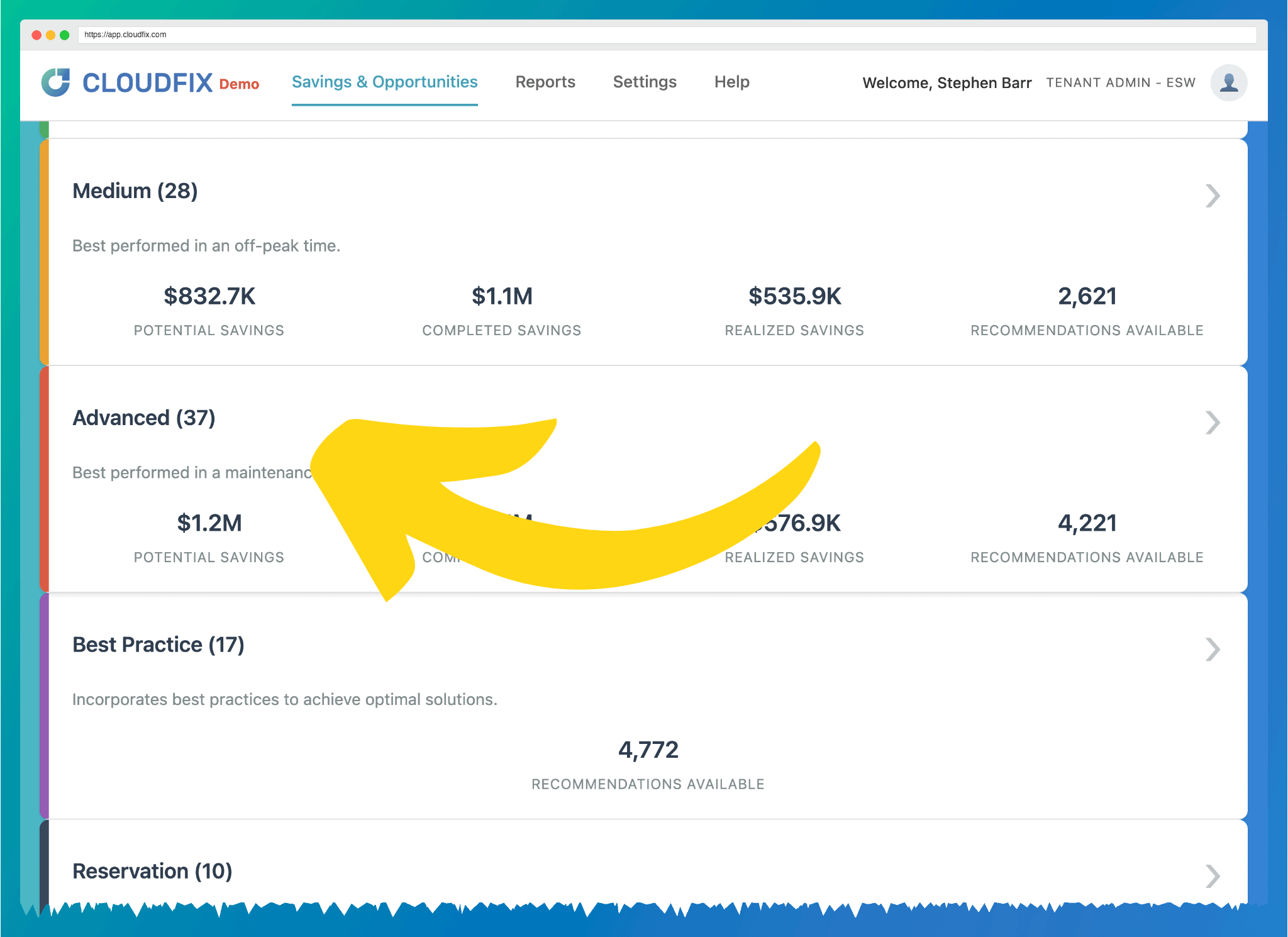
Click on the Advanced Finder/Fixer
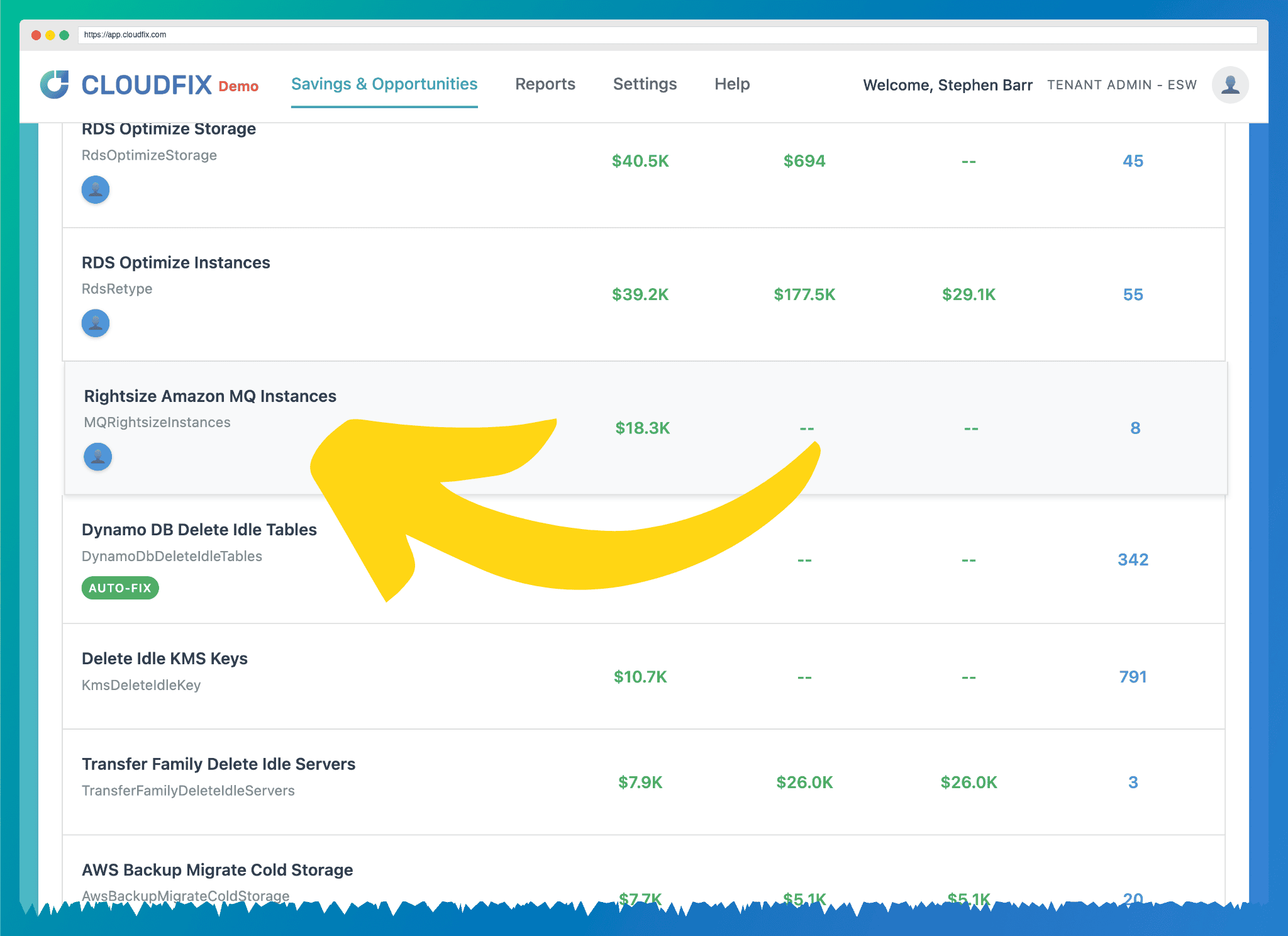
Right Size Amazon MQ Instances
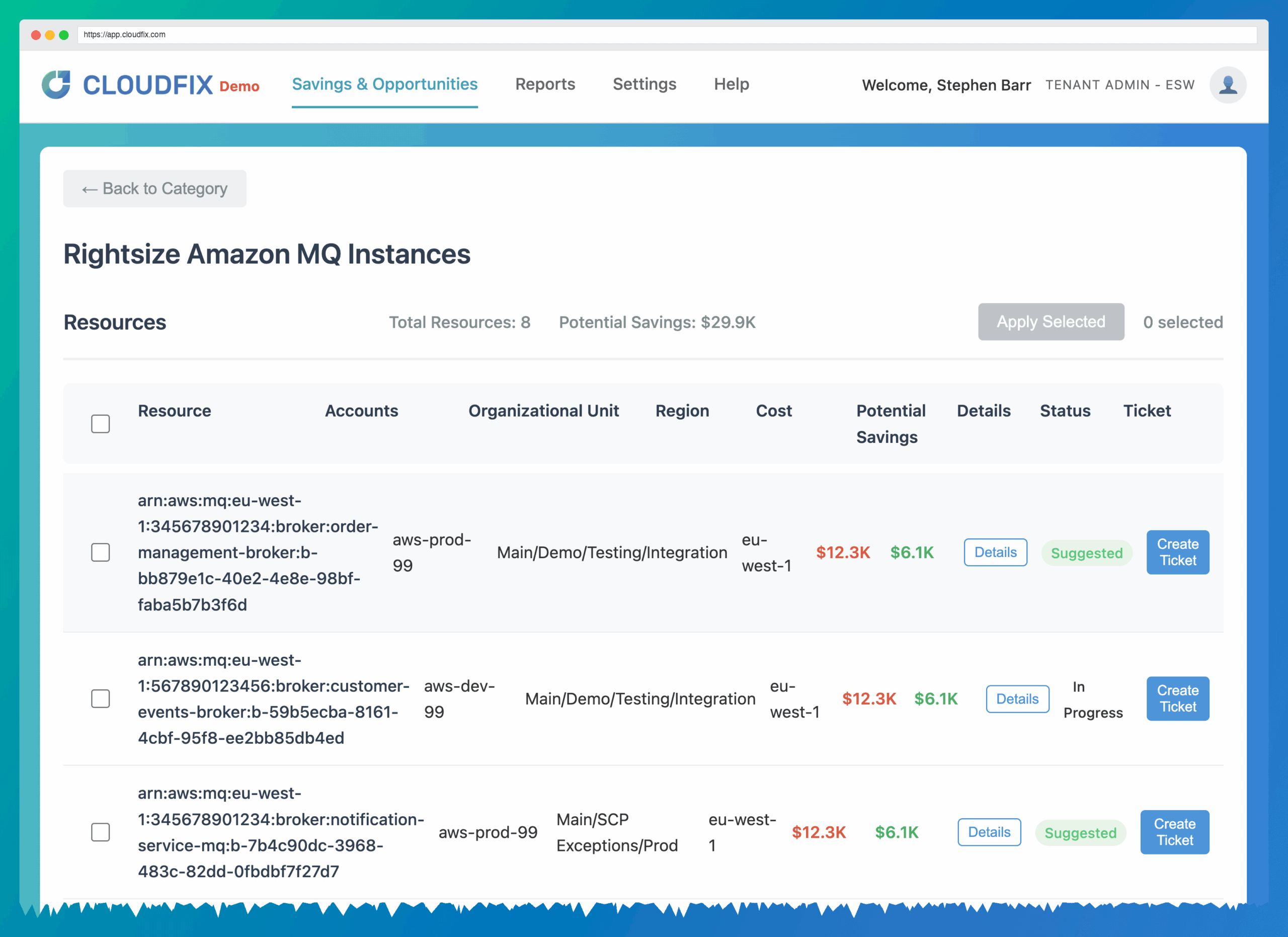
Select a MQ Right-Sizing Recommendation
Key Facts
- Comprehensive Engine Support: ActiveMQ and RabbitMQ brokers
- Safety buffers: headroom preserves peak performance, 5–10 minute downtime, all configs and messages preserved
- Side-by-Side Comparison: Current vs recommended with projected annual savings
FAQ: Amazon MQ Pricing & Optimization
Is Amazon MQ worth it vs self-hosted?
For most organizations, yes. You eliminate infrastructure management, patching, and upgrades. Fixed pricing is predictable, and AWS handles the broker software. The 2.5–3× premium pays for itself in reduced operational overhead.
How much can I save by rightsizing?
Most organizations see 30–60% savings: 40–50% on instance costs, 20–30% on storage, and 60–70% on development environments.
Does rightsizing impact performance?
When done correctly, no. CloudFix sizes each broker from its historical usage with headroom for peaks, you approve every change before it runs, and changes are meant to be applied in a maintenance window.
How often should I review MQ costs?
Monthly monitoring for usage trends, quarterly comprehensive reviews, and annual architecture reviews.
Can I use Amazon MQ for free?
AWS offers a Free Tier: 750 hours/month of mq.t3.micro for 6 months, limited to single-instance deployments.
Wrapping Up
Amazon MQ pricing optimization delivers significant savings: most organizations cut 30–60% through systematic rightsizing. The 2.5–3× MQ premium over EC2 makes this even more impactful: every oversized MQ instance is 2.5–3× more wasteful than an equivalent EC2 instance.
CloudFix automates the entire process: finding brokers, analyzing utilization, recommending optimal sizes, and applying changes during maintenance windows. Get a free assessment to see how much you could save.
Related Articles
- AWS Cost Optimization: The Complete Guide to Lowering Your Cloud Bill (2026)
- AWS Cost Optimization Tools: The Complete Comparison Guide (2026)
- EKS End-of-Life Migration Guide: Upgrade Strategies & Automated Optimization
- CloudFix Finder/Fixer: Kinesis Analytics Optimize Logs
- Autoscale Amazon Kinesis Streams for AWS Cost Savings